
A construction estimate is one of the most important documents a contractor will encounter on any project. Yet for many Alaska contractors — especially those newer to the trade or moving into larger commercial and civil projects — reading an estimate correctly can feel overwhelming. Line items, trade divisions, markup percentages, allowances, and contingency figures all appear on the same page, and misreading even one section can mean the difference between a profitable job and a costly loss.
This guide walks you through every part of a professional construction estimate, explains what each section means, and shows you exactly how to use an estimate to make smarter bidding and budgeting decisions in Alaska.
1. What Is a Construction Estimate?
A construction estimate is a detailed, itemized document that predicts the total cost of completing a construction project. It is prepared by an estimator — either in-house or by a third-party estimating firm — and is based on project drawings, specifications, site conditions, and local market data.
A good estimate is not a rough guess. It is a calculated projection that accounts for every material, every labor hour, every piece of equipment, and every overhead cost required to build a project from the ground up. In Alaska, a thorough estimate also incorporates region-specific factors such as freight costs, seasonal labor premiums, permafrost engineering, and remote site logistics.
Estimates serve several purposes depending on the project stage:
- Bid Estimates: Submitted to owners or general contractors during competitive bidding
- Budget Estimates: Used by developers and owners to establish project feasibility
- Conceptual Estimates: Prepared in early design stages before drawings are complete
- Definitive Estimates: Final, detailed estimates prepared from complete construction documents
2. The Standard Structure of a Construction Estimate
Professional construction estimates in Alaska are typically organized using the CSI MasterFormat — a standardized numbering system developed by the Construction Specifications Institute. Understanding this structure is the first step to reading any estimate correctly.
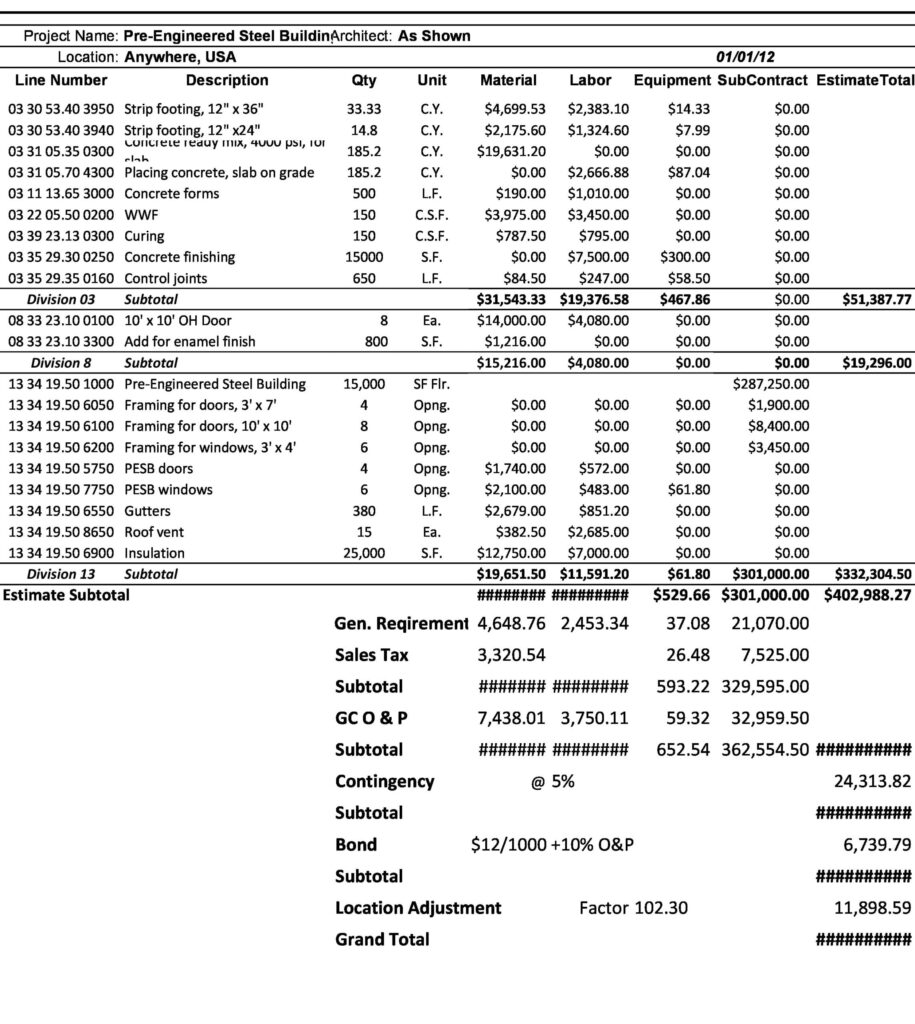
The CSI MasterFormat divides all construction work into numbered divisions. Here are the most commonly encountered divisions in Alaska residential and commercial estimates:
| CSI Division | Division Name | Common Work Items |
| Division 01 | General Requirements | Mobilization, temporary facilities, project management |
| Division 02 | Existing Conditions | Demolition, site clearing, hazardous material removal |
| Division 03 | Concrete | Foundations, slabs, concrete walls, piles |
| Division 04 | Masonry | Brick, block, stone work |
| Division 05 | Metals | Structural steel, metal framing, stairs |
| Division 06 | Wood & Plastics | Lumber, framing, millwork, casework |
| Division 07 | Thermal & Moisture | Insulation, roofing, waterproofing, air barriers |
| Division 08 | Openings | Doors, windows, glazing, hardware |
| Division 09 | Finishes | Drywall, flooring, painting, tile |
| Division 10 | Specialties | Signage, toilet partitions, fire extinguishers |
| Division 21–23 | Fire / HVAC / Mechanical | Sprinklers, HVAC systems, mechanical equipment |
| Division 26 | Electrical | Wiring, panels, fixtures, low-voltage systems |
| Division 31–33 | Earthwork & Utilities | Grading, excavation, site utilities |
When you open an estimate, look for these division numbers in the left-hand column. They tell you immediately what type of work is being priced on each line.
3. Anatomy of a Single Estimate Line Item
Every line item in a construction estimate follows the same basic structure. Understanding what each column means will let you review any estimate quickly and confidently.
| Column | What It Means |
| Item / Description | A brief name for the work being priced — e.g., ‘3.5″ Batt Insulation, Exterior Walls’ |
| Quantity | The measured amount of work — e.g., 4,200 SF, 18 LF, 12 EA |
| Unit | The unit of measurement — SF (square feet), LF (linear feet), CY (cubic yards), EA (each) |
| Unit Cost | The cost per single unit of that item, covering material and/or labor |
| Total Cost | Quantity multiplied by Unit Cost — the extended price for that line item |
| Labor Hours | Some estimates show projected hours separately to help with scheduling |
| Notes / Spec Ref | References to project specification sections or assumptions made by the estimator |
Example: If you see a line item that reads — Fiberglass Batt Insulation, R-38, Attic | 3,200 SF | $1.85/SF | $5,920 — that means the estimator has measured 3,200 square feet of attic area, priced R-38 insulation at $1.85 per square foot installed, and arrived at a total installed cost of $5,920 for that specific item.
Reading estimates this way — line by line — lets you verify quantities, challenge unit costs if they seem off, and understand exactly where your money is going on a project.
4. Understanding the Cost Components
A professional construction estimate breaks down cost into distinct components. Each plays a different role in the total project price. Here is what each means:
Material Costs
Material costs represent the purchase price of all physical materials incorporated into the project — lumber, concrete, steel, insulation, doors, windows, fixtures, and so on. In Alaska, material costs are typically 15% to 30% higher than national averages due to freight, shipping, and the limited availability of local suppliers.
When reviewing material costs in an Alaskan estimate, check whether the estimator has used Alaska-specific pricing or national pricing databases. National databases such as RSMeans often underestimate Alaska material costs significantly, especially for remote projects.
Labor Costs
Labor costs cover the wages paid to workers who perform the construction work. These are typically presented as a combination of hours and hourly rate. In Alaska, labor costs are among the highest in the United States. Journeyman carpenters in Anchorage earn $65 to $85 per hour including benefits and union contributions. Electricians and plumbers commonly run $75 to $110 per hour.
Labor productivity is also a key factor in Alaska. Cold weather, remote site conditions, and shorter construction seasons reduce worker output per hour compared to the Lower 48, which experienced estimators account for with productivity adjustment factors built into their rates.
Equipment Costs
Equipment costs cover the rental or ownership cost of machinery used on the project — excavators, cranes, concrete pumps, lifts, compressors, and so on. In Alaska, equipment mobilization costs (transporting machinery to and from remote sites) can be a major budget item. Equipment costs are often listed as a separate line item in Division 01 or broken out within each relevant trade division.
Subcontractor Costs
When a general contractor prices work that will be performed by a specialty subcontractor — such as roofing, mechanical, electrical, or plumbing — those costs are often shown as lump-sum subcontractor allowances in the estimate. A good estimate will still break these down into material, labor, and overhead components so the GC can evaluate each trade’s pricing independently.
Overhead and Profit (O&P)
Overhead and profit appear at the bottom of most estimates as a percentage markup on top of all direct costs. General overhead — covering office staff, insurance, vehicles, software, and general operating expenses — typically runs 10% to 18% for Alaska contractors. Profit margin typically adds another 8% to 15% depending on project type and competitive conditions.
When comparing bids, always check whether overhead and profit are included in the quoted figures. Some subcontractors quote direct costs only, while others include their full markup. Comparing the two directly leads to incorrect conclusions about which bid is lower.
5. Allowances, Contingencies, and Escalation
Three line items that confuse many contractors — allowances, contingencies, and escalation — deserve special attention.
Allowances
An allowance is a placeholder dollar amount included in an estimate for work whose scope has not yet been fully defined. For example, a lighting fixture allowance of $12,000 means the estimate includes $12,000 for light fixtures, but the specific fixtures have not yet been selected. If the owner chooses fixtures that cost $18,000, the contract price adjusts accordingly.
In Alaska estimates, allowances are common for items such as owner-selected finishes, specialty equipment, and permit fees that vary by borough. As a contractor, always identify every allowance in an estimate and confirm with your client what expectations exist around each one.
Contingency
A contingency is a percentage of the total estimate set aside to cover unforeseen costs — scope changes, site surprises, design errors, and other unknowns that emerge during construction. For Alaska projects, contingency is not optional. Permafrost surprises, weather delays, material shortages, and logistics issues are routine, not exceptional.
A properly funded contingency for Alaska projects typically ranges from 10% to 15% of the total project cost. For remote sites or projects on difficult terrain, 15% to 20% is more appropriate. Be wary of any Alaska estimate that carries zero contingency — it is either naive or intentionally underpriced to win a bid.
Escalation
Escalation accounts for the anticipated rise in material and labor costs between the date the estimate is prepared and the date the work is actually performed. In Alaska, where supply chains are long and material pricing can shift quickly, escalation is a legitimate and important line item on any project with a construction start date more than three months out. A typical escalation factor for Alaska projects in 2026 runs between 3% and 7% per year.
6. How to Spot a Weak or Incomplete Estimate
Not all estimates are created equal. A poorly prepared estimate can lead to contract disputes, budget overruns, and project failures. Here are the key warning signs Alaska contractors should watch for when reviewing any estimate:
- No breakdown by trade or CSI division. If the estimate is presented as a single lump sum with no itemization, it is impossible to verify whether all work has been covered.
- Unit costs that appear too low for Alaska. If labor rates look like Lower 48 averages or material pricing does not reflect Alaska freight costs, the estimate is likely undercooked.
- Missing or zero contingency. Any Alaska project without contingency is not a realistic estimate. It is either a sales tool or a mistake.
- No allowances for permits or fees. Building permits in Alaska range from $2,500 to $25,000 depending on project size and municipality. An estimate that ignores permits will produce a surprise bill later.
- No mention of freight or logistics. For any project outside Anchorage or the MatSu Valley, freight and mobilization costs can represent 10% to 20% of the total project budget.
- Vague scope descriptions. Estimate line items that read ‘Miscellaneous Electrical Work — $45,000’ with no further breakdown provide no useful information for contract or cost management purposes.
- No reference to the drawings or specifications used. A credible estimate will always identify which set of drawings and which specification revision it is based on.
7. How to Compare Multiple Bids Using the Estimate
When you receive multiple bids for a project, comparing them intelligently requires more than looking at the bottom-line total. A bid comparison should evaluate each proposal at the trade level. The following steps will help you conduct a thorough bid comparison:
- Confirm that all bidders have priced the same scope of work. Differences in bid price are meaningless if the bidders have included or excluded different items.
- Compare unit costs for major items. If one bidder prices concrete at $185 per cubic yard and another prices it at $240 per cubic yard, ask both to explain their pricing.
- Check contingency and allowance treatment. Make sure all bids treat contingencies and allowances the same way.
- Review overhead and profit percentages. A 25% combined O&P markup is not unusual for Alaska specialty contractors. A 12% markup may indicate a contractor cutting corners or planning to recover costs through change orders.
- Evaluate schedule assumptions. Ask each bidder whether their pricing assumes a specific construction season or timeline. A lower price that assumes a compressed summer schedule may carry more risk than a slightly higher price from a contractor who plans the work realistically.
- Request a clarifications list from each bidder. Professional estimators attach a list of assumptions, exclusions, and clarifications to their proposals. This document often explains large price differences better than the estimate itself.
8. Alaska-Specific Line Items to Look For
A thorough Alaska construction estimate will include line items that would not typically appear on a Lower 48 project. If any of the following are missing from an estimate for an Alaskan project, ask your estimator why:
| Alaska-Specific Line Item | Typical Cost Range | Notes |
| Freight & Material Shipping | $15,000 – $80,000+ | Varies significantly by location and material volume |
| Equipment Mobilization | $8,000 – $60,000 | Transport of heavy equipment to and from site |
| Permafrost Investigation & Testing | $5,000 – $20,000 | Geotechnical report and soil testing |
| Pile or Elevated Foundation | $40,000 – $120,000 | Required in permafrost regions |
| Frost-Rated Utility Lines | $10,000 – $40,000 | Water and sewer lines must be insulated and buried below frost depth |
| Winter Work Premium | 10% – 20% on labor | Applies when exterior work must continue during winter months |
| Remote Site Accommodation | $15,000 – $50,000 | Worker housing and camp costs for fly-in or boat-in sites |
| Seasonal Construction Window Delay | $10,000 – $50,000+ | Carrying costs if project misses construction season |
| Permitting — Remote Borough | $3,000 – $15,000 | Permitting fees vary widely across Alaska boroughs |
| Fuel and Generator Costs | $5,000 – $30,000 | Off-grid sites require on-site power generation |
If you are reviewing an estimate prepared by an out-of-state estimating firm and none of these line items appear, treat the estimate with caution. Generic national pricing models consistently underestimate Alaska project costs.
9. Common Mistakes Contractors Make When Reading Estimates
- Focusing only on the total. The bottom line is the least useful number on an estimate without context. Always review the detail before drawing conclusions from the total.
- Ignoring exclusions. Every professional estimate includes an exclusions list — items that are specifically not covered in the price. Missing an exclusion can result in a contractual dispute or an unexpected cost burden.
- Accepting round numbers without question. An estimate line item that reads exactly $50,000.00 for a complex scope of work is almost certainly a placeholder, not a calculated figure. Ask for the supporting detail.
- Not checking quantities against the drawings. Estimating errors in quantity takeoff are common even among experienced estimators. Spot-checking key quantities against the drawings takes 30 to 60 minutes and can catch errors worth thousands of dollars.
- Confusing the estimate with the contract. An estimate is a cost projection — it is not a fixed-price commitment unless it is incorporated into a lump-sum contract. Always confirm the contract type (lump sum, cost-plus, GMP) before assuming the estimate figure is what you will be charged.
- Not asking for clarification. If any section of an estimate is unclear, ask. Reputable estimators expect questions and will explain their methodology and assumptions in detail.

Frequently Asked Questions
What is the difference between an estimate and a quote?
An estimate is a calculated projection of expected costs based on quantities, unit prices, and assumptions. A quote — sometimes called a bid or proposal — is an offer to perform specific work at a defined price. A quote becomes legally binding when accepted; an estimate is informational. In practice, the terms are often used interchangeably in Alaska, so always clarify whether a number you receive is fixed or subject to change.
How accurate should a construction estimate be?
The accuracy of a construction estimate depends on the information available at the time it is prepared. A conceptual estimate prepared from early schematic drawings typically carries an accuracy range of plus or minus 20% to 30%. A detailed estimate prepared from complete construction documents should be accurate to within 5% to 10%. At Alaska Estimation, our estimates achieve 94% to 97% accuracy through ZIP-code-based pricing, thorough quantity takeoffs, and direct coordination with Alaska material suppliers.
Should I trust an estimate that uses national pricing data for an Alaska project?
Not without verification. National pricing databases such as RSMeans include location adjustment factors for Alaska, but these multipliers are based on broad regional averages and do not capture the specific freight costs, labor premiums, and logistical challenges of individual Alaska locations. An estimate for a project in Bethel, for example, requires very different pricing than a project in Anchorage, even though both are in Alaska. Always use an estimator with direct Alaska experience and access to current, local pricing data.
What does CSI MasterFormat mean on an estimate?
CSI MasterFormat is a standardized system for organizing construction specifications and cost information, published by the Construction Specifications Institute. It divides all construction work into numbered divisions (01 through 49) that cover every trade from general conditions to earthwork to mechanical and electrical systems. An estimate organized in CSI format is easier to review, easier to compare against other bids, and easier to use for contract management and cost control throughout a project.
What should I do if I think an estimate is missing items?
First, check the exclusions list at the end of the estimate document. If an item is not on the exclusions list and not in the estimate, raise it with the estimator in writing and ask for a revised estimate that includes the missing scope. Never assume a missing item will be covered — in construction contracts, what is not written is generally not included.
| Get a Precise, Alaska-Ready Construction Estimate from Alaska Estimation Reading an estimate is only half the challenge — you also need an estimate worth reading. Generic, out-of-state estimating services routinely underestimate Alaska project costs because they rely on national pricing databases that do not reflect Alaska’s freight premiums, labor rates, or regional site conditions. That gap between the estimate and the actual cost is where contractors lose money, lose bids, and lose clients. Alaska Estimation delivers construction estimates built specifically for the Alaska market. Our certified estimators produce CSI Master Format takeoffs with 94% to 97% accuracy, ZIP-code-based material and labor pricing, and full coverage of Alaska-specific cost drivers including permafrost engineering, freight, mobilization, and seasonal construction factors. We serve general contractors, subcontractors, developers, and owners across all project types — residential, commercial, industrial, civil, MEP, and remote site construction. Every estimate is delivered within 24 to 48 hours, fully itemized, and ready to use for bidding, budgeting, or contract management without revision. If you are tired of estimates that do not hold up once a project starts, partner with a team that has completed 1,600+ Alaska construction estimates and understands what accurate pricing looks like in this state. Visit alaskaestimation.com to submit your project drawings and get a detailed estimate you can actually trust. Website: alaskaestimation.com | Phone: +1 (718)-540-5178 | Email: info@linkestimation.comAddress: 1152 Rhode Island Avenue, Anchorage, Alaska 99501 |