
If you have ever requested a construction estimate in Alaska and compared it to a similar project in Texas, Florida, or even the Pacific Northwest, the sticker shock can be jarring. Alaska consistently ranks as the most expensive state in the country to build in, with construction costs running 30% to 90% higher than the national average depending on project type and location.
But why? The answer is not simple. It is the product of geography, climate, logistics, labor markets, regulatory frameworks, and the sheer physical remoteness of much of the state. This article breaks down every major factor driving Alaska’s elevated construction costs so you can plan smarter, budget more accurately, and avoid the financial surprises that derail too many projects.
Alaska vs. Lower 48: Construction Cost Premium at a Glance
| Cost Factor | Lower 48 Average | Alaska Premium | Est. Added Cost |
| Freight & Logistics | Minimal | +15% – +30% | $30,000 – $90,000 |
| Labor Rates | National baseline | +30% – +50% | $40,000 – $120,000 |
| Foundation (Permafrost) | Standard slab | +$30k – +$120k | $30,000 – $120,000 |
| Insulation & Weatherproof | Standard code | +10% – +20% | $20,000 – $60,000 |
| Remote Site Access | N/A | +20% – +60% | $25,000 – $150,000 |
| Fuel & Energy Systems | Standard | +15% – +30% | $15,000 – $55,000 |
| Seasonal Build Windows | Year-round | +5% – +15% | $10,000 – $40,000 |
| Permitting & Compliance | Standard | +5% – +10% | $5,000 – $20,000 |
1. Geography and Freight: The Cost of Getting Materials to Alaska
Alaska is physically separated from the continental United States by Canada. There are no highways that connect Alaska directly to the Lower 48 supply chain. Every sheet of drywall, every bag of concrete, every electrical fixture, and every structural steel beam must either be shipped by barge, transported by truck through Canada, or flown in by cargo plane. This fundamental logistics reality is the single biggest driver of elevated construction costs in the state.
Barge and Sea Freight
The majority of heavy construction materials arrive in Alaska via ocean barge. The Alaska Marine Highway and private barge operators connect Southeast Alaska and major ports, but delivery windows are seasonal and schedules are rigid. Missing a barge window can delay a project by weeks or even months. Freight costs for materials shipped to Anchorage, Kodiak, or Juneau typically run 12% to 20% above the purchase price of the materials themselves.
Trucking Through Canada
For projects in Interior Alaska and along the road system, materials are often trucked via the Alaska Highway through British Columbia and Yukon Territory. This route adds 1,500 to 2,000 miles of overland freight compared to a delivery in the Lower 48, translating to significantly higher transportation costs, longer lead times, and exposure to border crossing delays and Canadian import duties.
Air Freight for Remote Sites
For construction sites without road or barge access — which includes a significant portion of rural Alaska — materials must be flown in by bush plane or cargo aircraft. Air freight rates in Alaska run $0.80 to $3.50 per pound depending on destination, making even modest material quantities extremely expensive to transport. A single pallet of hardware that costs $2,000 to freight to a Seattle job site might cost $12,000 to $18,000 to fly to a remote Alaska location.
Supplier Availability and Material Sourcing
Alaska has a limited local manufacturing base. Unlike states in the Lower 48 where contractors can source lumber, concrete, steel, and MEP components from multiple regional suppliers, Alaskan contractors often have access to only one or two distributors for key materials. This limited competition keeps material prices elevated and reduces the ability to negotiate bulk discounts.
2. Labor Costs: Skilled Workers in a Thin Market
Construction labor is the second largest cost driver in any project, and in Alaska the labor premium is substantial. Several interconnected factors push wage rates well above national benchmarks.
High Cost of Living Attracts a Wage Premium
Alaska has one of the highest costs of living in the United States. Groceries, housing, fuel, and everyday services all cost more in Alaska than in most Lower 48 states. To attract and retain skilled tradespeople, employers must pay wages high enough to offset this cost-of-living burden. As of 2026, journeyman carpenters in Anchorage earn $62 to $85 per hour including benefits, compared to a national average closer to $42 to $55. Electricians and plumbers command $70 to $110 per hour in major Alaska markets.
Union Labor Agreements
Alaska has a strong union presence in the construction trades. Union collective bargaining agreements set prevailing wage floors for most commercial and public construction projects. While union labor provides quality assurance and accountability, it also establishes minimum wage structures that are significantly higher than many Lower 48 markets. Projects subject to Davis-Bacon Act prevailing wage requirements — which covers most federally funded Alaska infrastructure — must pay certified union-rate wages for every trade involved.
Contractor Mobilization Costs
Many specialty subcontractors who work in Alaska are not based there permanently. Structural steel erectors, curtain wall installers, elevator technicians, and other specialized tradespeople often fly in from Seattle, Portland, or other Lower 48 hubs. Mobilization costs — airfare, per diem, housing, and equipment transport — are passed directly to the client and can add $15,000 to $60,000 to a project budget depending on the number of specialty trades involved and the project duration.
Limited Labor Pool in Rural Areas
Outside of Anchorage, Fairbanks, and Juneau, the available pool of licensed contractors shrinks dramatically. In rural communities, there may be only one or two qualified general contractors operating within 200 miles of a project site. This near-monopoly environment gives contractors significant pricing power and eliminates the competitive bidding pressure that keeps costs in check in more populated markets. Rural Alaska projects routinely pay 40% to 70% more for labor than equivalent Anchorage projects.
3. Permafrost and Foundation Engineering
Approximately 85% of Alaska’s land area is underlain by permafrost — ground that remains frozen year-round and can extend hundreds of feet below the surface. Permafrost is not simply frozen soil; it is a dynamic structural medium that expands, contracts, heaves, and settles in response to temperature changes, drainage patterns, and surface disturbance. Building on permafrost without proper engineering leads to foundation failure, structural cracking, and in severe cases complete building collapse.
Standard Foundations Are Not an Option
The conventional slab-on-grade foundation used in the vast majority of Lower 48 residential and commercial construction cannot be safely used on permafrost. Heat generated by a building gradually thaws the permafrost beneath it, causing differential settlement as the ground softens unevenly. This process, known as thermokarst, is responsible for the tilted, sunken, and structurally compromised buildings visible across Alaska’s interior communities.
Engineered Foundation Solutions and Their Costs
Alaska contractors use several specialized foundation approaches to address permafrost, each carrying significant cost premiums over standard foundations:
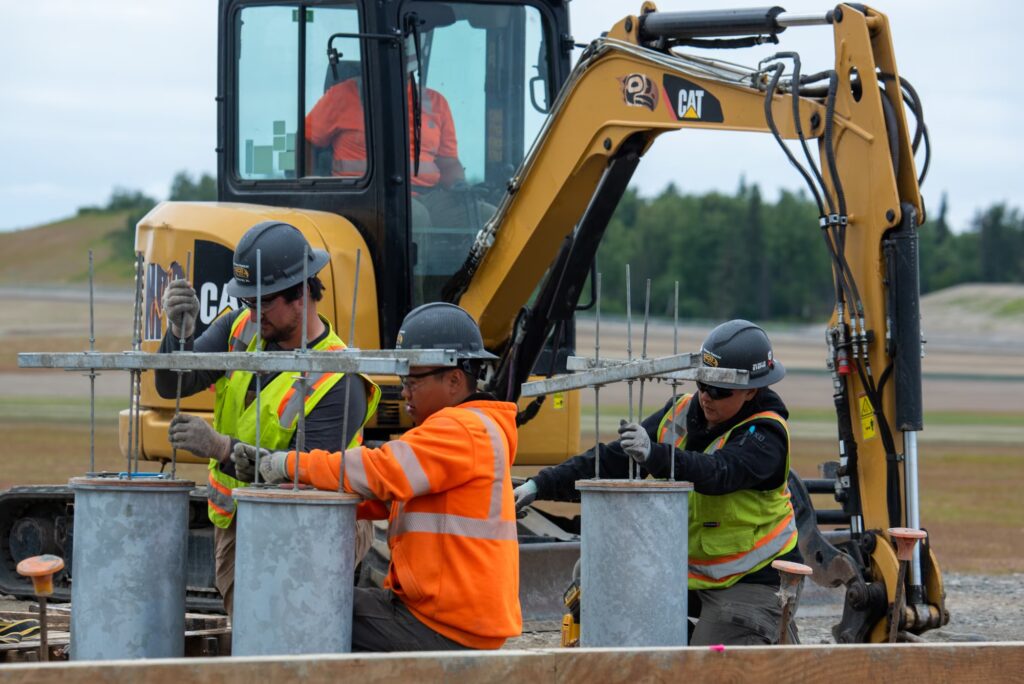
- Driven Pile Foundations: Steel H-piles or pipe piles are driven deep into stable permafrost below the active layer. A typical residential project requires 20 to 40 piles, with total foundation costs ranging from $45,000 to $100,000.
- Elevated Platform Systems: The building is raised on posts or piles, allowing cold air to circulate beneath and maintain the permafrost in a frozen state. Foundation costs range from $35,000 to $85,000.
- Thermosyphon Systems: Passive heat exchange devices installed alongside piles that extract heat from the ground during winter, maintaining permafrost integrity. Adds $15,000 to $40,000 on top of pile foundation costs.
- Insulated Pad Foundations: A thick layer of rigid insulation is placed between the building and the ground to minimize heat transfer. Costs range from $25,000 to $60,000 and are suitable only in areas of marginal permafrost.
By comparison, a standard poured concrete slab foundation for an equivalent building in the Lower 48 would cost $12,000 to $30,000. The permafrost premium alone can add $30,000 to $80,000 to a typical residential project budget.
4. Extreme Climate and the Cost of Building for Survival
Alaska’s climate is not simply cold — it is extreme in ways that directly translate into higher construction specifications and costs across nearly every building system.
Structural Loads: Snow, Wind, and Seismic
Alaska building codes require structures to be engineered for snow loads that far exceed Lower 48 standards. Roof designs in many regions must accommodate 100 to 150 pounds per square foot of snow accumulation. Wind loads in coastal and mountain communities can exceed 150 mph design speeds. Alaska also sits along the Pacific Ring of Fire and is one of the most seismically active states in the nation — Anchorage alone has experienced multiple major earthquakes above magnitude 6.0 in recent decades. Designing structures to meet these combined load requirements demands heavier structural members, more robust connection details, and additional engineering review time, all of which add cost.
Insulation and Envelope Requirements
Alaska’s energy codes mandate insulation levels that are among the highest in the United States. The Alaska Residential Building Code requires minimum R-values of R-38 to R-60 for ceilings and attics, R-21 to R-30 for exterior walls, and R-30 for floors over unheated spaces. Meeting these requirements demands spray foam insulation, continuous exterior insulation layers, and triple-pane window systems that cost two to three times as much as the double-pane units standard in most Lower 48 climates. A properly insulated Alaska home envelope can cost $40,000 to $90,000 more than an equivalent structure in a temperate climate.
Heating Systems
Heating in Alaska is a life-safety issue, not simply a comfort feature. The consequences of a heating system failure during an interior Alaska winter — where temperatures can drop to minus 40 degrees Fahrenheit or colder — can be catastrophic within hours. This reality drives several cost increases: heating systems must be oversized with significant reserve capacity, backup heating systems are required or strongly recommended, fuel storage infrastructure adds expense, and mechanical rooms must be designed to protect equipment from freeze-up. A complete residential heating system in Alaska, including primary and backup heating, fuel storage, and distribution infrastructure, typically costs $25,000 to $60,000 — compared to $8,000 to $18,000 for a standard forced-air system in the Lower 48.
Cold-Weather Construction Practices
When construction must continue through Alaska’s winter months — as is often necessary to meet project schedules — significant additional costs are incurred. Temporary enclosures, heated work tents, ground thawing equipment, concrete heating systems, and cold-weather curing protocols all add to project expense. Winter construction typically increases overall project cost by 8% to 18% compared to equivalent work performed during the summer building season.
5. Short Construction Seasons and Scheduling Constraints
In most of the Lower 48, construction can proceed year-round with only minor weather interruptions. In Alaska, the practical exterior construction season runs from approximately May through October in Southcentral Alaska, and is even shorter in the Interior and Arctic regions. This compressed construction window creates significant cost pressures that ripple through every phase of a project.
Compressed Scheduling and Overtime
To complete a project within a single construction season, contractors must often run extended workdays and weekend shifts. Overtime labor premiums — typically 1.5 times the standard rate — add directly to project costs. In Alaska, seasonal time pressure routinely adds 5% to 12% to overall labor budgets compared to projects that can be scheduled without seasonal urgency.
Material Pre-Ordering and Storage Costs
Because barge and freight schedules are tied to seasonal navigation and weather windows, materials must be ordered and delivered months in advance of their actual use. This requires contractors to maintain significant on-site material storage, which adds warehouse rental costs, increases exposure to material damage, and ties up capital in inventory. Pre-ordering also limits the ability to respond to design changes without incurring costly material returns or expedited freight charges.
Project Delays and Carrying Costs
A project that misses its construction season completion target — due to weather, material delays, permitting issues, or subcontractor scheduling conflicts — must typically wait 6 to 8 months for the next viable work window. This delay carries real financial costs: construction loan interest continues to accrue, contractor mobilization must be repeated, and any completed work exposed to the elements over winter may require remediation or repair before the project can resume.
6. Fuel and Energy Costs
Fuel is a pervasive cost driver in Alaska construction that affects everything from equipment operation to worker housing. Alaska’s fuel prices are among the highest in the nation, with diesel — the lifeblood of construction equipment — typically running 30% to 60% above Lower 48 prices in major markets and 100% to 200% above national averages in remote communities accessible only by air or barge.
Heavy construction equipment including excavators, cranes, bulldozers, and concrete trucks all run on diesel. Extended equipment operation in cold weather increases fuel consumption by 15% to 25% due to the energy required to maintain operating temperatures and overcome the increased resistance of cold lubricants and hydraulic fluids. Generator power for job site electrical needs, heating systems for concrete curing and worker accommodations, and fuel for project vehicles all contribute to a fuel cost burden that meaningfully exceeds equivalent Lower 48 projects.
7. Permitting, Regulatory Compliance, and Environmental Requirements
Alaska’s regulatory environment reflects the state’s unique environmental sensitivities and land management complexity. A significant portion of Alaska’s land is managed by federal agencies including the Bureau of Land Management, the U.S. Forest Service, the U.S. Army Corps of Engineers, and the National Park Service. Construction in or near wetlands, navigable waters, or federal lands requires additional permitting layers that add time, legal fees, and compliance costs not encountered on most Lower 48 projects.
Wetlands and Water Body Permits
Alaska contains more wetland area than all other U.S. states combined. Section 404 permits from the U.S. Army Corps of Engineers are required for any construction that involves the discharge of fill material into wetlands or navigable waters. Obtaining these permits can take 6 to 18 months and requires environmental assessments, agency coordination, and in some cases mitigation measures such as wetland restoration projects. Permit-related delays and compliance costs add $10,000 to $75,000 or more to projects in sensitive areas.
Cultural Resource and Tribal Consultation
Alaska is home to more than 200 federally recognized tribes and has extraordinarily rich archaeological and cultural resources. Federal undertakings and many state-permitted projects require Section 106 consultation with tribal governments and state historic preservation offices to identify and protect cultural resources. This process adds months to permitting timelines and, if cultural resources are encountered during construction, can result in significant project delays and mitigation expenses.
8. Infrastructure Deficits and Utility Connection Costs
In much of the Lower 48, construction sites connect to existing municipal water, sewer, natural gas, and electrical infrastructure that was built out over decades. This infrastructure is largely taken for granted in project budgets. In Alaska, particularly outside of Anchorage and a few other developed municipalities, this infrastructure either does not exist or is prohibitively expensive to extend.
Water and Sewer
Many Alaska communities and rural areas rely on individual well and septic systems rather than centralized municipal water and sewer. Well drilling in Alaska is complicated by permafrost, bedrock, and the need for specialized equipment. A residential well in Alaska can cost $15,000 to $45,000 depending on depth and location, compared to $5,000 to $12,000 in most Lower 48 markets. Septic system permitting and installation adds another $12,000 to $35,000.
Electrical Service
Grid-connected electrical service in Alaska is expensive both to install and to operate. Many rural communities operate on isolated microgrids powered by diesel generators, where electricity costs $0.50 to $1.00 per kilowatt-hour — five to ten times the national average. Connecting a new building to even a nearby electrical grid can cost $15,000 to $60,000 depending on distance and terrain. For truly remote properties, off-grid systems incorporating solar panels, wind generators, battery storage, and diesel backup represent a capital investment of $40,000 to $150,000.
Road Access and Site Preparation
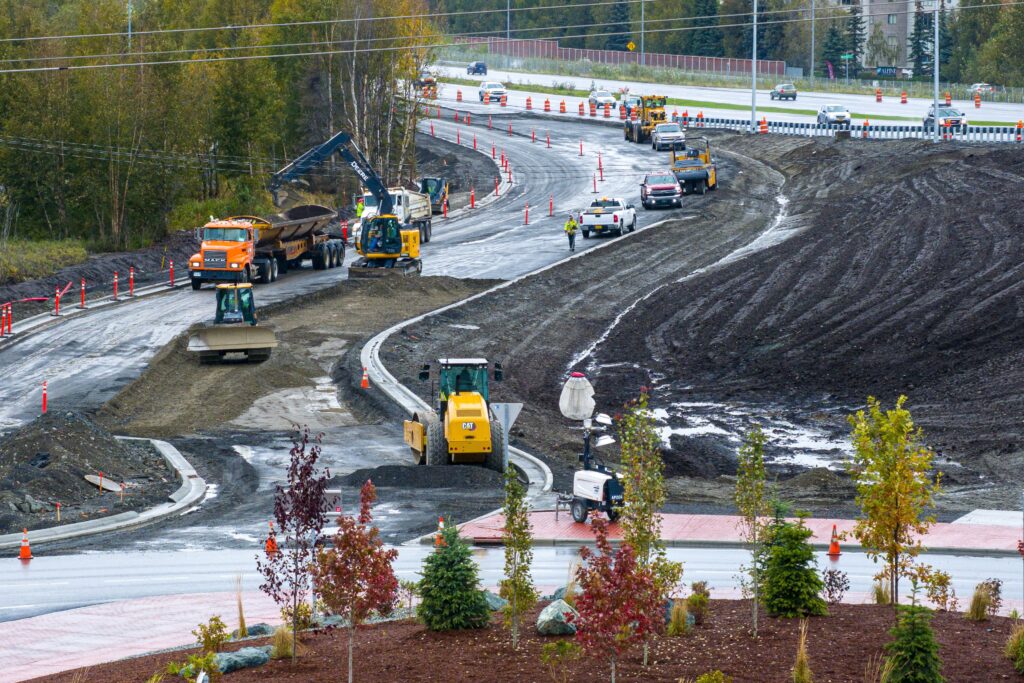
Many Alaska construction sites lack adequate road access. Building access roads, clearing and grubbing heavily wooded or brush-covered sites, and establishing stable construction staging areas in remote locations can add $20,000 to $100,000 to project budgets before a single structural element is placed. These costs are essentially nonexistent for the vast majority of Lower 48 construction projects on road-accessible, previously developed sites.
9. The Cumulative Effect: How These Factors Stack Up
Individually, each of the cost factors described above might seem manageable. The challenge is that they do not occur in isolation — they compound. A remote Alaska construction project simultaneously faces elevated freight costs, higher labor rates, specialized foundation requirements, extreme weather construction practices, shorter build windows, expensive fuel, complex permitting, and absent infrastructure. The cumulative effect is a project cost structure that is simply not comparable to equivalent work in the Lower 48.
Consider a 2,500 square foot commercial building. In Denver, Colorado, the same building might cost $600,000 to $750,000 to construct. In Anchorage, that same building would likely run $900,000 to $1,200,000. In Fairbanks, $1,050,000 to $1,400,000. In a remote Interior Alaska community accessible only by air, costs could easily reach $1,500,000 to $2,000,000 or more — two to three times the national benchmark.
Regional Cost Comparison: Alaska vs. Lower 48 (2026)
| Region | Cost Multiplier vs. National Avg | Primary Drivers |
| National Average (Lower 48) | 1.00x (baseline) | Standard conditions |
| Pacific Northwest (Seattle) | 1.20x – 1.35x | Labor, regulatory |
| Hawaii | 1.40x – 1.60x | Freight, labor |
| Anchorage, AK | 1.30x – 1.50x | Freight, labor, climate |
| Fairbanks, AK | 1.45x – 1.65x | Permafrost, cold, logistics |
| Juneau, AK | 1.40x – 1.60x | No road access, barge freight |
| Rural / Bush Alaska | 1.70x – 2.50x+ | Air freight, no contractors, remote sites |
10. What This Means for Contractors, Developers, and Homeowners
Understanding why Alaska construction costs are elevated is not just an academic exercise — it has direct practical implications for anyone planning or bidding a project in the state.
For General Contractors
Using national cost databases or Lower 48 historical pricing to estimate Alaska projects is a formula for financial loss. Every trade, every material category, and every logistical component must be re-priced using Alaska-specific data. Contractors who bid Alaska projects based on mainland benchmarks consistently underbid, absorb losses, or walk away from contracts mid-project.
For Developers and Owners
Project feasibility analyses based on Lower 48 comparable costs will systematically underestimate total development costs and skew return-on-investment calculations. A project that pencils out financially at $800 per square foot in California may require $1,200 to $1,500 per square foot in Alaska to be accurately underwritten. Understanding the true cost baseline is essential before committing to land acquisition, financing, or design development.
For Homeowners
Budget surprises are common among homeowners who enter Alaska construction projects without Alaska-specific cost guidance. Mid-project cost overruns and unexpected budget gaps are among the most stressful and financially damaging outcomes of underestimating construction costs at the planning stage. A professional Alaska construction estimate before finalizing plans and financing is not an optional luxury — it is essential risk management.
Frequently Asked Questions
By how much do Alaska construction costs exceed the national average?
Depending on location and project type, Alaska construction costs typically run 30% to 90% above the national average. Urban projects in Anchorage cluster toward the lower end of this range, while remote rural builds can exceed national benchmarks by 100% to 150% or more.
Is it possible to reduce costs on an Alaska construction project?
Yes, with careful planning. Key strategies include selecting building sites on the road system to minimize freight costs, choosing panelized or modular construction systems to reduce on-site labor hours, ordering materials well in advance of the build season, working with an Alaska-specific estimator to identify value engineering opportunities, and building contingency reserves into budgets from the outset.
How does permafrost affect construction cost specifically?
Permafrost requires specialized foundations that can cost $40,000 to $120,000 more than standard foundations. It also limits construction scheduling, requires ongoing geotechnical monitoring in some cases, and can cause expensive damage to buildings that were not properly designed for permafrost conditions.
Are construction costs in Anchorage significantly different from rural Alaska?
Yes, substantially. Anchorage benefits from road access, a larger contractor base, and established supply chains. Rural Alaska builds without road access commonly cost 50% to 100% more than comparable Anchorage projects due to air freight, fly-in contractor mobilization, and the absence of local subcontractor competition.
What is the most expensive line item on an Alaska construction project?
For most projects, labor is the largest single cost component at 30% to 40% of total project cost. However, on remote projects, freight and logistics can approach or exceed labor costs as a percentage of total budget.
Get Alaska-Accurate Estimates from Alaska Estimation
Understanding why construction costs in Alaska are higher than the Lower 48 is only the first step. The second — and more important step — is making sure your project budget reflects those realities before you commit to a design, a contractor, or a financing package. Generic national cost estimating software and rule-of-thumb pricing from the Lower 48 will fail you in Alaska. The freight premiums, labor rates, foundation engineering, permafrost considerations, and logistical complexities described in this article must all be individually priced and incorporated into a project-specific estimate.
Alaska Estimation is a specialized construction estimating firm with over 20 years of experience delivering accurate, Alaska-specific estimates for residential, commercial, industrial, civil, and institutional projects across the state. From Anchorage subdivisions to remote bush construction sites, our certified estimators understand the real-world cost drivers that shape every Alaska project budget.
Our estimating services include full quantity takeoffs from architectural and engineering drawings, ZIP-code-based labor and material pricing calibrated to Alaska conditions, foundation and permafrost cost analysis, freight and logistics cost modeling for remote sites, MEP system estimating for electrical, mechanical, and plumbing trades, and CSI MasterFormat formatted reports that are ready for bidding, financing, and insurance purposes.
We deliver 94% to 97% accurate estimates within 24 to 48 hours. Over 1,600 Alaska construction projects have been estimated by our team, giving us the data depth and regional knowledge to produce numbers you can actually build from.
Do not let an inaccurate estimate become the most expensive decision on your project. Contact Alaska Estimation today and get the precision your Alaska build deserves.
Website: alaskaestimation.com
Phone: +1 (718)-540-5178
Email: info@linkestimation.comAddress: 1152 Rhode Island Avenue, Anchorage, Alaska 99501